
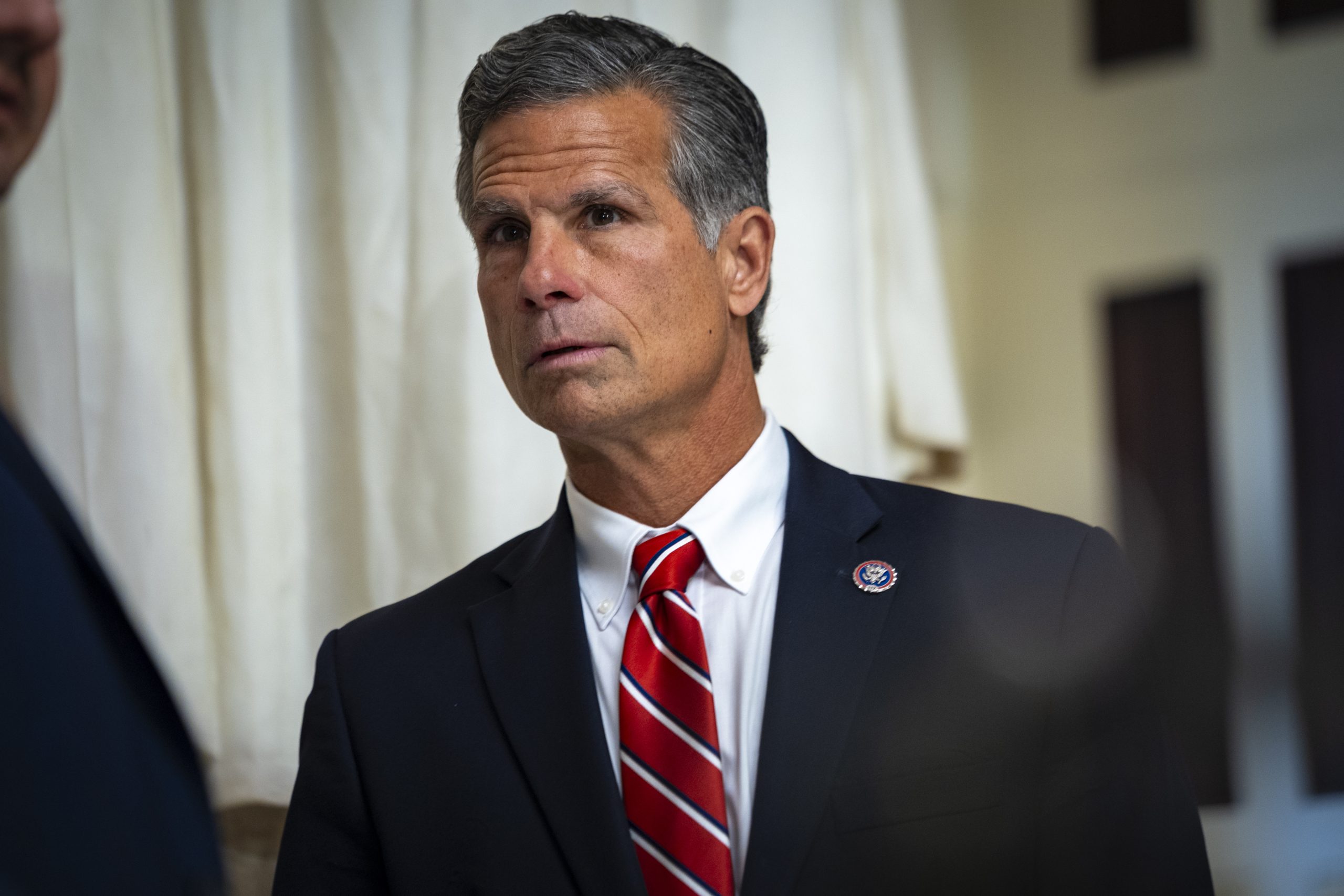
- This is the fourth article in Pocono Review’s ongoing investigation into Rep. Dan Meuser.
- Read Part 1: Meuser Wins Primary Unopposed. His Campaign Spent $1.5 Million Anyway.
- Read Part 2: Dan Meuser Took the Money, Kept the Board Seat, Went to Congress.
- Read Part 3: Dan Meuser Gave Corbett $81,894. Corbett Gave Him a Cabinet Seat.
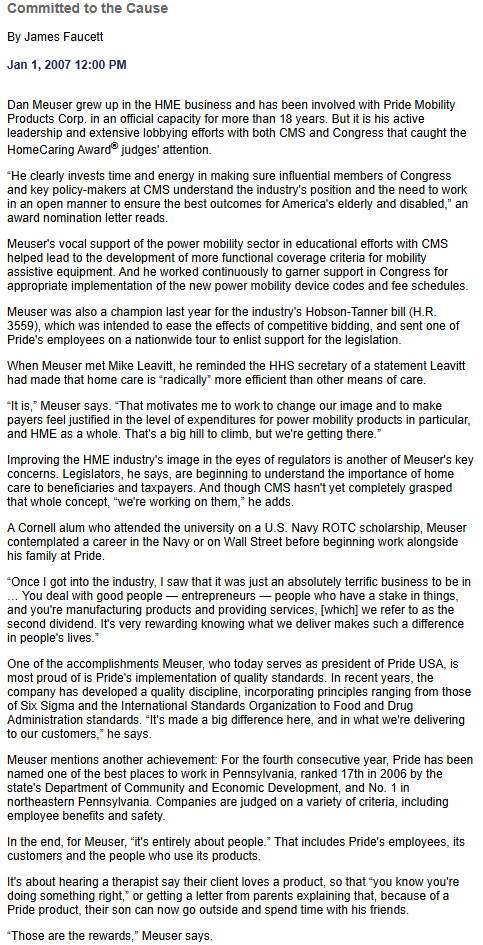
LULUZERNE COUNTY — In 2006, HomeCare Magazine gave Rep. Daniel Meuser (R-PA-9) its HomeCaring Award for what his nomination letter described as “active leadership and extensive lobbying efforts with both CMS and Congress” on behalf of the power mobility industry (HomeCare Magazine, 2006). He was, at the time, the president of Pride Mobility Products — a company whose revenue depended on Medicare reimbursements for power wheelchairs.
The award profile quoted him directly: “Legislators are beginning to understand the importance of home care to beneficiaries and taxpayers. And though CMS hasn’t yet completely grasped that whole concept — we’re working on them.”
The year before, he had championed the Hobson-Tanner bill, legislation intended to shield HME suppliers from competitive bidding, and deployed one of Pride’s own employees on a nationwide tour to build congressional support.
Two years later he left Pride to run for Congress. He lost. In 2011 he got a cabinet appointment. In 2019 he finally got to Washington.
He brought the same agenda with him.
The Letters
Since taking office, Meuser has signed three congressional letters to the Centers for Medicare and Medicaid Services pushing for expanded Medicare coverage of standing and seat elevation systems in power wheelchairs — the product category Pride Mobility manufactures.
The first, in October 2021, was addressed to CMS Administrator Chiquita Brooks-LaSure, urging the agency to establish Medicare coverage for standing systems in power wheelchairs (Sen. Duckworth’s office, Oct. 2021). A second followed in September 2022, again pushing CMS on the same issue (Medtrade, Sept. 2022). A third came in September 2024, with 15 House co-signers (HME News, Sept. 2024).
Each of these letters asked CMS to do something specific: expand Medicare reimbursement to cover a product category that Pride Mobility manufactures and sells. Pride Mobility’s Q3 2025 federal lobbying disclosure — filed with the Senate Office of Public Records and reviewed by Pocono Review via Quiver Quantitative — lists “Medicare coverage for power standing systems” as an active lobbying priority during the same period.
The congressman who sits on Pride’s board and collects at least $1 million a year from the company, per his 2023 House financial disclosure, was pushing the same policy in congressional letters. His campaign received $6,700 from Pride’s PAC during the 2023–2024 cycle, per FEC records — the same period he signed the third letter.
The Bill
In 2025, Meuser cosponsored H.R. 1703, the Choices for Increased Mobility Act. The bill requires Medicare to establish new billing codes for ultralightweight manual wheelchairs — separate codes for titanium and carbon fiber construction — and allows suppliers to charge patients the difference between Medicare reimbursement and the actual upgrade cost.
New billing codes directly affect how wheelchair manufacturers are reimbursed under Medicare. Pride’s 2025 lobbying disclosure lists “wheelchair upgrade legislation” alongside the standing systems push.
During the January 2026 hearing before the House Energy and Commerce health subcommittee, AAHomecare president Tom Ryan testified in support of the bill (HomeCare Magazine, Jan. 2026). AAHomecare is the HME industry’s national trade association.
Before entering Congress, Meuser sat on AAHomecare’s board of directors (Rehab Management, Oct. 2019).
The Money Trail
Pride Mobility Products Corp PAC is registered with the FEC as a corporate PAC. In practice, it is a family fund.
FEC records for the 2025–2026 cycle — reviewed by Pocono Review — show the PAC raised $30,000. Every dollar came from six people: Scott Meuser, Dan’s brother and Pride’s CEO. Stanley Meuser, their father. Veronica Meuser and Allison Meuser, family members. Thomas Kretchik and Felicia Kretchik, the co-founding family. Each gave $5,000 on November 24, 2025. No Pride employees contributed. No outside donors. The entire fund is controlled by two families.
The PAC’s disbursements in the current cycle show where that money goes. Meuser for Congress received $5,000 across three payments. DAN PA FIRST PAC — Meuser’s own leadership PAC, a separate vehicle that lets him redistribute money to other politicians — received another $2,500. That’s $7,500 to Meuser through two channels in a single cycle.
The PAC also sent $5,000 to the American Association for Homecare PAC — the HME industry’s trade association. AAHomecare’s PAC has separately given Meuser’s campaign $15,000 since 2018, per FEC filings for committee C00357129. The founding families’ money reaches Dan through two pipelines: directly through Pride PAC, and indirectly through the trade association Pride PAC helps fund.
In prior cycles, the PAC’s reach extended further. FEC records show $29,500 to Rep. Glenn Thompson of neighboring PA-15, $2,000 to the Duckworth Victory Fund — Senator Tammy Duckworth leads the Senate letters to CMS on standing systems that Meuser signs on the House side — and $1,000 to Rep. Randy Feenstra, who cosponsored the DMEPOS Relief Act protecting DME reimbursement rates.
The money maps to the legislation. Duckworth writes the Senate letter. Meuser signs the House letter. Feenstra cosponsors the reimbursement bill. The founding families fund the PAC that pays all of them.
Both brothers have been recognized by the industry for this work. Dan won the HomeCaring Award in 2006. Scott won AAHomecare’s Homecare Champion Award in 2013 (HME News, Oct. 2013).
Combined, Meuser has received at least $52,999 from the wheelchair and HME industry’s PACs since 2018 — not counting the $2,500 to his leadership PAC or the indirect pipeline through AAHomecare.
The Contrast
In 2019, Meuser voted no on H.R. 3, the Elijah Cummings Lower Drug Costs Now Act, which would have allowed Medicare to negotiate prescription drug prices. In 2022, he voted no on the Inflation Reduction Act, which capped insulin at $35 per month for Medicare beneficiaries and expanded Medicare drug price negotiation. He called it the “Recession Extension Act.” In 2025, he voted yes on the One Big Beautiful Bill, which restructured Medicaid eligibility and reimbursement. (Voting record per House Clerk roll call records.)
He votes against Medicare when it would benefit patients broadly. He advances Medicare expansions when they benefit the wheelchair industry specifically. In every cycle, the industry’s money is flowing to his campaign while his legislative activity tracks its lobbying agenda.
What He Said Then
In 2006, Meuser told HomeCare Magazine he was “working on” CMS.
He went to Washington in 2019 and kept working on them — signing letters, cosponsoring bills, collecting at least $1 million a year from a company whose revenue depends on the policies he’s advancing. There is no public record of him disclosing that relationship in the context of any of it.
The title changed. The work didn’t.
Tips: tips@poconoreview.com | Corrections: corrections@poconoreview.com