
Deputy Yosvani Quesada wrote 800 tickets in five months. Mainstream media called him confused.
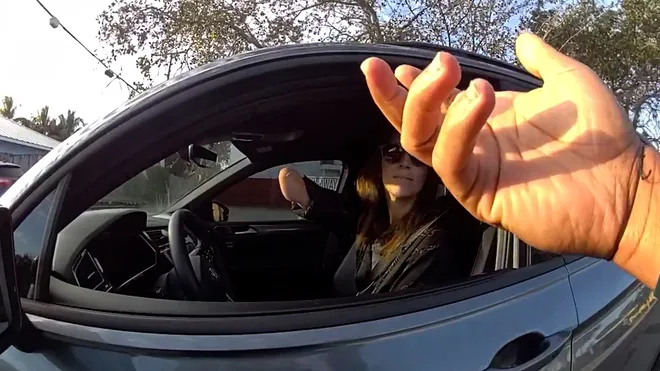
You’ve seen the bodycam footage by now. On February 11, 2026, Palm Beach County Sheriff’s Deputy Yosvani Quesada pulls over Kathleen “Katie” Thomas on North Dixie Highway in Lake Worth Beach, Florida, and tells her he saw her holding a phone in her right hand. Thomas laughs and raises her right arm. She doesn’t have a right hand. Born with a congenital limb difference, her arm ends below the elbow.
PBSO Deputy Quesada doesn’t flinch. “I mean, I saw you.” He asks her to swear “hand to God.” She raises the arm again. He tells her to raise her left hand instead, then writes a $116 citation under Florida Statute 316.305(3)(a). On May 27, 2026, Quesada requested the citation be dismissed, citing “insufficient evidence.” Not an error. Not a correction. Insufficient evidence — as though the problem was evidentiary and not the fact that the woman does not have the hand he described on the citation.
Court records show Quesada has written more than 800 traffic citations since January 1, 2026 — roughly 160 per month, about eight per working day. That volume tells you what kind of deputy PBSO stationed on North Dixie Highway for a distracted driving operation, and why he wasn’t walking away empty-handed just because the driver showed him she couldn’t have done what he claimed.
Every major outlet — CBS, NBC, ABC, TMZ, HuffPost — ran the same framing: a confused officer who didn’t know how to handle a person with a limb difference. Gayle King, on CBS Mornings, suggested Quesada simply didn’t know what to do. The media took Thomas’s grace and used it as the whole story, because it’s the version that doesn’t require asking harder questions about a deputy averaging 160 citations a month.
Rewind the bodycam. Before Quesada says a word about a phone or a right hand, he tells Thomas why she’s being stopped:
“This is why you’re being pulled over: the city of Lake Worth today, we’re doing an operation for distracted driver.” Lake Worth Beach hasn’t had its own police force since 2008, when PBSO absorbed the city’s department. Under Florida’s constitution, the sheriff is the highest law enforcement authority in the county — municipalities that contract with PBSO don’t direct operations. When Deputy Quesada said “the city of Lake Worth” was running an operation, he was giving a PBSO deployment the sound of a local decision.
Deputy Quesada was on assignment and when Thomas showed him the violation was physically impossible, he wrote the citation anyway. Not because he was confused. Because he had numbers to bring back.
The word nobody used
The word is quota.
Florida banned ticket quotas after the tiny town of Waldo was caught generating nearly half its municipal revenue from traffic citations. Waldo’s police force was disbanded on October 1, 2014; the legislature passed Florida Statute 316.640 7(b) in 2015. Two years later, two senior Florida Highway Patrol officials lost their jobs after emails surfaced demanding troopers write at least two tickets per hour as part of a taxpayer-funded overtime program. The practice doesn’t stop when you ban it. The vocabulary just changes. A quota becomes an “initiative.” An initiative becomes an “operation.” An operation becomes the first words out of Quesada’s mouth before he tickets a woman for using a hand she doesn’t have.
This isn’t a Florida story
Pennsylvania banned ticket quotas on October 30, 1981 — fourteen years before Florida got around to it. Act 114 bars any Commonwealth agency from directly or indirectly suggesting that any officer issue a set number of citations on any timeframe.
It didn’t matter.
In 2002, the Pittsburgh Post-Gazette uncovered that PSP had built a workaround called the “station average.” Troopers who wrote fewer tickets than their barracks colleagues got disciplined. PSP documents showed monetary rewards for high output, punishment for low output, and a deliberate internal effort to make sure nobody talked about it. That’s not a department that stumbled into bad policy. That’s a department that knew it was breaking the law and built a system designed to be deniable. The courts voided the tickets and found the program illegal.
Twenty-four years later, the system didn’t disappear. It got rebranded.
Operation Yellow Jacket
On May 28, 2026, PennDOT and PSP held a press conference in Dunmore to announce the results of this spring’s Operation Yellow Jacket across northeastern Pennsylvania. Troop R — covering Lackawanna, Wayne, Pike, and Susquehanna counties — reported 128 deployments and 1,612 citations and warnings in highway work zones. In 2024, the same operation across those same four counties produced 319 stops, 419 citations, and 86 warnings between April and June alone.
PSP Troop F Public Information Officer Trooper Sara Barrett told reporters in May 2026 that the goal of Operation Yellow Jacket “is not to issue citations, but to deter the unsafe behaviors that would result in violations.” Then the agency held a press conference to announce how many citations it issued. Pick one.
What the media gave you instead
Thomas told CBS she doesn’t think Quesada meant harm. Her advocacy for the limb difference community is real work that matters. But the national media took her framing and stopped there, because training gaps make for a tidy segment. Nobody has to answer for anything. Quesada needs a workshop. Roll credits.
Eight hundred citations in five months say otherwise. Most people pulled over during an “operation” can’t hold up an arm and prove the charge is impossible. They don’t have 330,000 TikTok followers or bodycam footage that goes viral. They pay the $116 and drive on.
On May 28, 2026, PSP stood at a podium in Dunmore and told you exactly how many tickets Troop R wrote in your work zones this spring. They were proud of the number. That’s the story.