
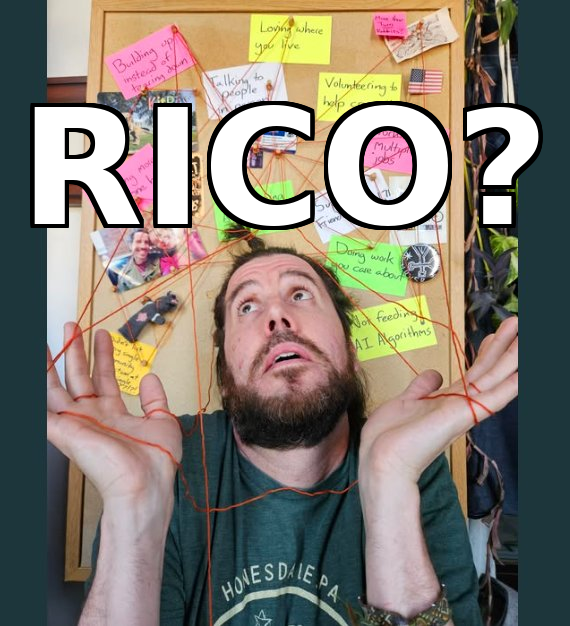
Honesdale, PA — In Part 1 of this investigation, Pocono Review documented the conduct of Candy Maylone — a participant in the People’s Playground Project who ran a weeks-long campaign to harass journalists, intimidate a sitting politician, and conceal her affiliation with the project and the people this outlet has been investigating. That article asked who sent her.
Read Part I: The PPP Affiliate Who Harassed Journalists, Threatened a Politician, and Hid Her Connection to All of It
Read Part III: People’s Playground Project Affiliate Sends Cease And Desist
Also Read: The Silence of Honesdale: What 10,000 Views and Two Loud Voices Tell Us About Fear in a Small Town
This one answers the question by documenting what she was protecting.
What follows is the financial and political structure behind the People’s Playground Project — built by Honesdale Mayor Derek Williams and his domestic partner Lisa Glover, funded through the Wayne County Community Foundation where Williams collects a salary, and insulated from public scrutiny at every turn. Every claim is sourced to public records, IRS filings, borough meeting minutes, state databases, or named individuals. The full reporting is at poconoreview.com.
Call It What It Is
Strip the scenery. Forget the coffee shop and the playground. Look at what these people did.
They move public money through a closed network of undisclosed relationships. They fabricated a pretext — a junk science report produced by a friend, billed to the borough as paid work, presented to the public as volunteerism — to tear out a public asset and replace it with a project they controlled. They routed the replacement funding through the mayor’s employer. They didn’t register with the state. They answered “No” on federal tax forms that asked about relationships never disclosed in any public meeting, borough record, or official document — relationships that only became visible when Pocono Review cross-referenced 990 filings, donor lists, board rosters, and meeting minutes no one had connected before. When one elected official asked questions, they destroyed him politically — stripped his committees, censured him a week before the election, buried the state letter that proved he was right. When a news outlet started publishing what the documents showed, someone inside the organization went after the journalists and the politician she believes was responsible. She concealed her connection. She deleted the posts that crossed the line. She told her targets “we know who you are.”
That is how an organized criminal enterprise operates.
Federal RICO law was not written exclusively for the Gambinos and the cartels. 18 U.S.C. § 1961 covers any group of individuals — formal or informal, incorporated or not — who conduct the affairs of an enterprise through a pattern of wire fraud, mail fraud, false statements, and intimidation. The statute does not care about the zip code. The conduct documented in this reporting is structurally identical: a closed financial loop, federal tax filings that appear to contradict the documented record, a manufactured crisis, political retaliation against oversight, and when the reporting started, an affiliate who showed up to threaten, intimidate, and suppress — then hid her connection and destroyed the evidence.
The mayor and his affiliate are pointing at the same person. Derek Williams has not responded to a single question Pocono Review has posed. What he has done is post staged photographs and public statements on his Mayor Derek Williams Facebook page — the page he uses to address the public in his official capacity — in response to our coverage. He has called this outlet fake, dismissed our reporting as AI-generated, and implied that Pocono Review is operated by Jim Hamill, the same councilmember Maylone targeted by name. He addresses the audience. He does not address the facts. Glover has said nothing at all. They don’t have to. People like Candy Maylone do the street-level work. That is how enterprises function. The architects insulate. The foot soldiers enforce. And when the foot soldier gets caught in the photograph she wasn’t supposed to be in, the entire structure becomes visible.
Maylone is in the photograph. The question prosecutors should be asking is who sent her to the comment section.
The Enterprise Behind Her
Candy Maylone didn’t build this. She’s a foot soldier. The structure she was protecting — knowingly or otherwise — was built by two people: Honesdale Mayor Derek Williams and his domestic partner Lisa Glover.
What follows is a summary of what Pocono Review has documented across twelve investigative articles published between April 29 and May 28, 2026. Every claim is sourced to public records, IRS filings, borough meeting minutes, state databases, or named individuals. The full reporting is at poconoreview.com.
The money loop. Derek Williams is an paid employee at WCCF. WCCF has not confirmed his exact position, but he styles himself as the “Community Engagement Manager” in interviews with certain media outlets. As mayor, he governs the borough that receives WCCF grants. As a WCCF employee, he works at the organization that writes, administers, and takes an administrative cut on those grants. Before WCCF, he worked at the Wayne County Department of Planning and GIS writing grants for borough projects. He moved from writing the applications to working at the foundation that processes them to governing the municipality that receives them.
WCCF’s expenses nearly doubled during his tenure — $1.36 million in FY2022 to $2.55 million in FY2025. Staff wages went from zero to $160,205. County grants to WCCF went from zero to $351,572.
The girlfriend’s organizations. Lisa Glover is the 2nd Vice President of the Wayne County Arts Alliance. WCCF sent WCAA at least $171,500 in a single fiscal year: $75,000 matching grant for a building purchase and $96,500 in program grants, making WCAA the second-largest organizational grant recipient in WCCF’s FY2023 filing behind only Wayne County government. Williams and Glover personally donated to the same WCAA building fund that WCCF’s matching grant capitalized. So did Williams’s parents, the Glover family, a WCCF board member at the $10,000 level, and a WCCF staff member. The bank whose CEO sits on WCCF’s board donated at the $10,000 level; its chairman donated separately. WCAA board members who ran the fundraising campaign donated to it themselves. A review of the donor wall shows network insiders accounted for a significant share of the $75,000 threshold required to unlock the matching grant from Williams’s own employer to his girlfriend’s organization.
Glover also sits on the board of Known Grove Sacred Land Stewardship, whose charitable fund is housed inside WCCF. Known Grove’s founder, Keenan Gruver, produced the unfinished soil report used to justify removing the Central Park playground. Gruver is a personal friend of Williams and Glover. Glover sits on his board. His nonprofit’s fund is administered by Williams’s employer. None of these relationships were disclosed to the public or to borough council when Gruver’s report was presented as the basis for tearing out a children’s playground.
The playground was removed on false pretenses. In October 2025, Honesdale tore out the Central Park playground. The sequence appears planned, not reactive.
Gruver presented a verbal report at an 8 AM Parks and Recreation Commission meeting claiming zinc contamination from tire mulch killed two sugar maples and endangered children. At no point was the public told that Gruver is a personal friend of Williams and Glover, that Glover sits on his board, that his fund is administered by Williams’s employer, or that Glover had been involved in Central Park projects since 2020. He was introduced as a nonprofit executive director. His report was, by his own admission, unfinished — “a full report is not ready as all the analysis reports were not received.” He holds no certification in soil science, arboriculture, or environmental testing. His self-described title is “Ecological Restoration, Systems Biology, & Cognitive Dendrology Consultant” — a discipline that doesn’t exist at any accredited institution. His prior tree-related employment was as a ground worker, entry-level manual labor.
The borough and the press told the public Gruver was a volunteer. He was not. Borough records show he requested a work order and invoiced approximately $1,200 for the report — a paid consultant billing the borough for work he wasn’t qualified to perform, presented to the public as a concerned citizen doing free community service.
The decision to remove the playground was made by interim borough manager Kevin Kundratic — a contractor from Luzerne County — in a single sentence at that meeting. No council vote, no written report, no public notice. The playground was gone twelve days later.
The Pennsylvania DEP subsequently sent the borough a letter confirming the soil did not exceed state standards. The borough buried it between a gas leak notice and a bank quote on a council agenda. Parents were never told. Gruver’s zinc reading — 797 PPM — was 1.2% of the PA DEP residential health standard of 66,000 PPM. The science was wrong. The credentials were fabricated. The “volunteer” was paid. The state cleared the soil. The borough told parents it was “necessary repairs.”
Before Gruver produced his contamination findings, Glover herself had publicly described the same soil as beneficial on the Honesdale Parks and Rec Facebook page, writing that keeping the dead stumps intact funneled “nutrients in the soil near these trees” into neighboring trees, making them “noticeably healthier this year than they were last year.” The soil was good — until her board member needed it to be bad. The diagnosis changed. The people behind it didn’t.
The entire pretext for removing the playground rests on an unfinished, unqualified report produced by a friend of the couple at the center of this story, billed to the borough as paid work, and misrepresented to the public as volunteerism. If that pretext was manufactured to create demand for a project the same network would control, the removal itself is not a mistake. It is an act in furtherance of an enterprise.
The replacement project. After the playground came out, Glover proposed PPP to borough council. PPP fundraises through WCCF — her partner’s employer. Co-founder Kendra Nelson was hired as Honesdale’s borough manager eleven days before council voted 5-2 to commit $400,000 to the project. PPP has solicited donations toward a $400,000 goal since October 2025 without registering with the Pennsylvania Bureau of Charitable Organizations — an apparent violation of 10 P.S. § 162.5. The only entity with visibility into how much PPP has collected is WCCF, which employs Derek Williams. No independent third party, no state agency, no auditor can see the numbers.
The tax filings. IRS Form 990, Part VI, Line 2 asks whether any officer, director, or key employee has a family or business relationship with another or with any organization doing business with the filer. WCCF answered “No” every year from 2021 through 2025. During those years Williams was on the payroll while serving as mayor of the borough WCCF funds, and Glover governed two WCCF-funded organizations. None of these relationships appear in any borough meeting minutes, public disclosure, or official record — they were uncovered by Pocono Review through cross-referencing IRS filings, donor lists, board rosters, corporate registrations, and meeting minutes. The “No” on the 990 didn’t contradict any public disclosure, because no public disclosure was ever made.
A knowingly false statement on a federal tax filing violates 26 U.S.C. § 7206. Whether these answers were knowingly false is a question for investigators with subpoena power.
The media capture. The River Reporter — the only newspaper covering the playground story for its first six months — published eight articles on Central Park without disclosing its reporter’s personal financial relationship with a PPP committee member. The disclosure appeared on the eighth and hasn’t been retroactively added to the prior seven. Williams wrote a column for the River Reporter before becoming mayor. His brother Ryan became the paper’s “News Ambassador” to borough council after Williams took office.
The political retaliation. Jim Hamill was the only person on council who publicly questioned the Williams-Glover-WCCF structure. In October 2025, one week before the mayoral election, council stripped him of all committee assignments. In November, at the same meeting where the DEP letter was buried and Glover presented PPP, council voted 5-1 to censure him. The censure relied partly on claims by Tiffany Rogers about the October 7 Parks and Recreation Commission meeting — but the borough’s own minutes, withheld from the public for six months, show Rogers logged off the virtual meeting at 9 AM, before the soil discussion occurred. Williams won reelection with 68.67% of the vote.
The RICO Question
Pocono Review is not a prosecutor’s office. We ask questions supported by public records and let readers draw conclusions.
Does the pattern of conduct documented across this outlet’s reporting meet the definition of a federal racketeering enterprise under 18 U.S.C. § 1961? The statute covers any group of individuals associated in fact, whether or not formally organized. An enterprise doesn’t need to be incorporated or formed for an illegal purpose — a legitimate community foundation can become a RICO enterprise if individuals conduct its affairs through a pattern of racketeering activity. The Supreme Court confirmed this in Boyle v. United States (2009). A “pattern” requires at least two predicate acts within ten years.
Wire fraud. PPP solicited charitable donations through interstate electronic communications toward a $400,000 goal, without state registration, while representing itself as a community-driven volunteer effort. If donors contributed based on a false representation of PPP’s independence from the financial structure documented in this reporting, those solicitations are potentially fraudulent wire communications. PPP is not the only unregistered entity in this network. Pocono Review has confirmed that the Wayne County Arts Alliance — where Glover serves as 2nd Vice President — has operated without a valid Pennsylvania charitable registration since 2014, soliciting hundreds of thousands of dollars including a building fund campaign that raised over $150,000. WCAA received $96,500 from WCCF in the first fiscal year Williams appeared on its payroll. Before he was hired, WCCF sent WCAA nothing. WCAA’s building fund required $75,000 in community donations to unlock the WCCF matching grant. A review of the donor wall shows that Williams, Glover, their families, a WCCF board member, a WCCF staff member, WCAA board members who ran the fundraising campaign, and the bank whose CEO sits on WCCF’s board accounted for a significant share of that threshold — network insiders funding themselves past the trigger point for a grant from one of their own employers. Two organizations in the same network, both connected to Glover, both soliciting public money without state registration. One is a decade-long lapse. The other launched that way from the start.
Honest services fraud. A mayor directing public resources — grant applications, borough partnerships, council votes, a $400,000 commitment — toward entities that financially benefit his household, without disclosure, while collecting a salary from the intermediary foundation, raises the question under 18 U.S.C. § 1346. If any of those communications moved through interstate wires or mail, the fraud statute attaches.
Obstruction and witness intimidation. Candy Maylone — photographed at a PPP planning session — ran a sustained campaign to discredit and intimidate the journalists documenting the enterprise and the politician she believed was behind the reporting. She concealed her affiliation, directed threats at the outlet covering the enterprise’s fundraising compliance, and attempted to identify and shame the councilmember who had questioned the enterprise’s operations. If any federal proceeding arises from this reporting, that campaign is relevant to § 1512.
The associated-in-fact enterprise. Williams, Glover, Gruver, Nelson, and their affiliates share a common purpose, maintain ongoing personal, professional, organizational, and financial relationships, and have operated together from at least 2022 to 2026. They don’t need to be incorporated or to have formed their relationships for an illegal purpose. They need only to have conducted the affairs of the enterprise through a pattern of racketeering activity.
What the public needs to decide. A mayor whose employer profits from every grant his borough receives. A domestic partner who holds officer positions at organizations receiving those grants. A paid consultant — on the girlfriend’s board — whose junk science report created the pretext to tear out a playground so the girlfriend’s project could replace it. An unregistered fundraising operation routing money through the mayor’s employer with no independent oversight. Federal tax filings that appear to contradict the documented record. A captive newspaper. A censured councilmember. Hidden meeting minutes. A buried DEP letter. And now: an affiliated individual running an intimidation campaign against the press while hiding her connection to the project.
Is that a pattern of racketeering activity conducted through an associated-in-fact enterprise?
We’re asking the question. The FBI, the IRS Criminal Investigation Division, the U.S. Attorney’s Office for the Middle District of Pennsylvania, and the Pennsylvania Attorney General’s Office can answer it.
Pocono Review has posed detailed questions to Mayor Derek Williams, Lisa Glover, the People’s Playground Project, and the Wayne County Community Foundation across multiple prior articles. None have responded. Those questions — and the silence that followed — are part of the public record at poconoreview.com.
Pocono Review covers Wayne, Monroe, Pike, Carbon, Lackawanna, and Luzerne counties. Tips, documents, and on-the-record accounts: tips@poconoreview.com. We never name our sources.
The Pennsylvania Attorney General’s Bureau of Charitable Organizations accepts complaints about unregistered charitable solicitation at attorneygeneral.gov. The FBI accepts tips at tips.fbi.gov. The IRS Criminal Investigation Division accepts referrals at irs.gov/compliance/criminal-investigation.
Pocono Review is committed to accuracy. If you believe any fact in this report is incorrect, email corrections@poconoreview.com with the specific claim and your supporting documentation. Verified corrections will be published promptly.