
Opinion & Analysis
Is Oressa Campbell defending Kaitlin White? Or is she managing her?
I can’t prove the answer. Nobody can. What I can do is lay out every documented fact, tie it together with some speculation, then ask you to decide what you believe is happening.
The Odds
Start with the appointment itself.
Between the Wayne and Pike County bar associations, over 120 attorneys were available. Add every lawyer in Lackawanna, Monroe, and Susquehanna counties within an hour’s drive. Add the fact that Pennsylvania courts routinely arrange counsel from outside the county when local conflicts exist. The pool was effectively bottomless.
Out of that pool, Judge Meagher appointed the one attorney who:
Employed Kaitlin White’s first public defender. Lindsey Collins joined Campbell Law Offices in 2013. Her biography still says so, in present tense. Collins was the first lawyer on White’s case. Campbell was the last. The appointment brought White’s representation full circle back to the same office, and nobody told her.
Sat on a nonprofit board with the prosecutor. Campbell and Brendan Ellis served together on Pro Bono Partnerships Inc. He was Treasurer. The nonprofit’s mailing address is Campbell’s office. Never disclosed.
Runs her own version of the Wayne County arrangement one county over. In Pike, Campbell is simultaneously a court-appointed Master, Hearing Officer, Mediator, Guardian Ad Litem, conflict counsel, and bar association president. She has appeared as the child’s attorney and the parent’s attorney in the same dependency case. She faces the same opposing counsel, Christine Rechner, in every dependency case on the Pike docket, and Rechner runs her bar association out of Campbell’s office. Campbell doesn’t just have conflicts. Conflicts are her business model.
She Has done this job before.
This is the one people miss, and it’s sitting in a federal court record. In 2009, Campbell was Pike County’s CYS Solicitor. The agency’s director, Dawn Metzger, arranged a psychiatric evaluation for a child in county custody. A county commissioner with no authority over placements ordered her to cancel it. Metzger reported him to the state. The same day, the commissioners suspended her, and they solicited reports to justify it. Campbell provided one, telling the commissioners Metzger had acted “in contravention of CYS policy.” Metzger was terminated. The record of all of it is in Metzger v. Pike County, filed in federal court. When the system needed a lawyer to help remove a person who threatened it, Campbell was the lawyer. That was seventeen years ago. The question this piece asks is whether it just happened again.
Maybe that was chance. In a small legal community, maybe the wheel just landed there.
Fine. Let’s say it did. Because what happened next is where chance stops being an explanation.
The Denial
On April 30, Campbell moved to withdraw. She told the court there was a conflict. She never said what it was. Not in the motion. Not on the record. Not ever.
White didn’t fight it. She told the court, on the record: if that’s what Campbell wants, “I will seek private counsel.”
Understand what that moment was. The defendant and her attorney both wanted out of the relationship. Replacing Campbell cost the system nothing. The case had already dragged two years through five attorneys, so a sixth changed nothing. The pool of available replacements was over a hundred deep. The defendant offered to pay for her own lawyer.
And the court said no.
Ellis, the prosecutor, argued to keep Campbell on the case. Read that again. The prosecutor fought to preserve the defense attorney. He told Meagher there was “no actual conflict” and that White just didn’t like “what a good job Miss Campbell has done for her.” Meagher agreed and denied the motion.
Prosecutors do not fight to keep defense attorneys. Adversaries don’t select their opponents. Unless the opponent isn’t one.
You don’t fight to keep a fungible appointment in place. Any of a hundred lawyers can stand next to a defendant at a plea hearing. You fight to keep a specific person in place when that specific person is doing something a replacement might not do.
So what was Campbell doing that a replacement might not?
What a Handler Does
Here is where I’m going to speculate, openly. I’ll tell you what I think, and I’ll put the documents under every sentence so you can check my thinking against the record.
A defense attorney attacks the prosecution’s case. A handler manages the defendant’s expectations until the prosecution gets its outcome. Read Campbell’s own emails and tell me which one she was.
The prosecution claimed to have evidence that sealed its case. It was never produced in discovery. A defense attorney demands that evidence, and when it doesn’t appear, files a Brady motion and puts the violation on the record. Campbell instead relayed the prosecutor’s verbal description of it to her own client, in writing, as a reason to plead. She took evidence nobody had seen and converted it into pressure. That’s not defense work. That’s delivering the prosecutor’s message.
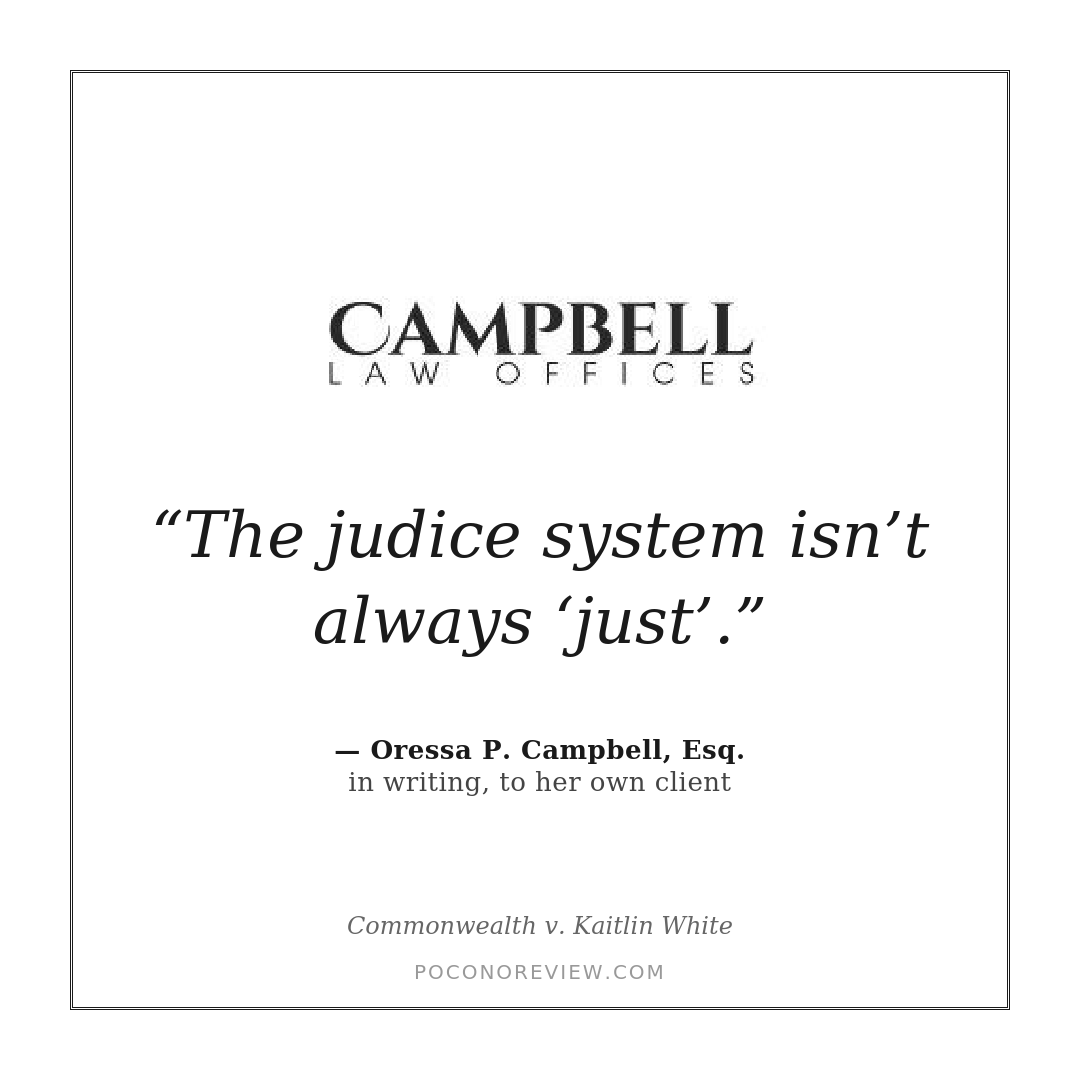
A defense attorney who believes the system is rigged fights harder and builds the record for appeal. Campbell wrote to her client that “the judice system isn’t always ‘just'” and used it as the argument for surrender. She identified the corruption and weaponized it against her own client’s will to fight. Take the deal, because the game is fixed. Who benefits from a defendant believing that? Not the defendant.
A defense attorney prepares her client for hearings. Campbell filed her withdrawal motion at 9:41 the morning of the April 30 hearing and let White find out in open court. When White accused her, on the record, of being part of a conspiracy, Campbell translated it for the judge into an “ineffective assistance of counsel claim.” A legal term. A manageable category. What White actually said, that the lawyers in the room were connected and none of them were fighting for her, never made it into the framing. The one time the truth got spoken in that courtroom, White’s own attorney buried it in procedure.
And the pressure campaign. Three months of it, in writing. “You need to be prepared to make a BUSINESS decision.” “Your window to have it resolved with your freedom guaranteed ended today.” “I can only imagine the thought that this might be your last week of freedom.” When White tried to negotiate terms, Campbell accused her of “backtracking into other stuff.” A nolo offer appeared and vanished within hours on May 6. Five days later White pleaded from a Sheetz parking lot, three hours from the courthouse, while her attorney stood by.
The BUSINESS decision line deserves a second look. Campbell was telling the truth. There was a business decision on the table. She just left out whose business it was.
Every one of those choices is consistent with a bad lawyer. I’ll grant that. But they are all, every single one, also consistent with a lawyer whose actual assignment was to land the plea. And the difference between those two explanations is the withdrawal denial. Incompetence gets replaced. This didn’t.
The Exit
Now watch the sequence at the end, because the timing tells its own story.
June 16: Campbell petitions for additional legal fees. June 18: Meagher approves them. Two days. Where the money comes from, nobody can say. Wayne County publishes no conflict counsel fee schedule. Pro Bono Partnerships, the nonprofit at Campbell’s address that took in $109,841 in IOLTA money over seven years, has never disclosed a single expenditure. The two contracts PBP is known to have awarded went to Lindsey Collins, Campbell’s law partner, and Michael Farley, the bar association secretary now sitting in county jail on felony assault and witness intimidation charges. The web page announcing those contracts has been deleted. Somebody thought that information was better off gone.
June 30: Campbell files a motion to withdraw White’s plea. Four grounds, no specifics. Ellis attacks it as “conclusory labels,” and on that narrow point he’s right. It reads like a motion written to exist rather than to win. The record now shows a plea withdrawal was attempted and denied on the merits. If this ever reaches an appellate court, that checkbox matters, and it cuts against White.
July 2: Campbell moves to withdraw as counsel. This time she cites the broken relationship. Still no mention of the PBP board. Still no mention of Collins. Still no mention of anything that would explain what she meant on April 30.
Get paid. File the motion that fails. Ask for the door. If you were designing an exit for a handler whose assignment was complete, what would you change?
As of this writing, Meagher hasn’t ruled on the withdrawal. Which puts White in the worst position the system can manufacture. Her attorney of record has told the court, in a filing, that she cannot appropriately represent her. But she’s still counsel. White can’t get a new lawyer because she technically has one. She can’t rely on the one she has because that lawyer has formally declared the relationship broken. Sentencing is July 14. White has no working counsel, no copy of the pre-sentence report that will determine her punishment (Meagher denied her one, going further than even Ellis asked), and a record that now says her plea challenge was heard and rejected.
Why She Couldn’t Fight, Even If She Wanted To
Here’s the part that makes the speculation hard to dismiss. Set aside intent entirely. Assume Campbell wanted to fight. She couldn’t have.
Fighting meant attacking Ellis, her fellow PBP board officer. It meant filing motions before Meagher, the judge who approves her fees, in a courthouse where his former law partner was the man she’d be attacking. It meant putting undisclosed relationships on the record in a legal community where her entire income depends on those relationships staying undisclosed. Her CYS contracts. Her conflict counsel appointments. Her Master and Mediator positions in Pike, assigned by a judge she swapped bar association offices with. Her standing with the Wayne County Bar Association, whose president’s son was White’s assistant public defender before Campbell, and whose vice-president is the prosecutor’s wife, a sitting magistrate judge still listed in the bar directory as a practicing attorney at Ellis Law Group.
And it cuts both ways. Ellis and Meagher know Campbell’s Pike County conflicts as well as we do. Better, probably. They’ve watched her hold seven roles, switch sides mid-case, and take appointments from judges she came up with. She can’t expose their arrangement without inviting scrutiny of her own. They know where her bodies are buried because they’ve spent years standing next to her at the shovel. That’s not a professional community. That’s mutual leverage. And mutual leverage is the one arrangement that guarantees nobody ever talks.
Ellis and Meagher didn’t need Campbell to be corrupt. They needed her to be exactly what she is: an attorney who cannot afford adversarial lawyering in their courtroom. Whether she took the assignment knowingly or just performed it by instinct is the one thing the record can’t tell us. The outcome is identical either way.
And this is where Pike County stops being background and becomes evidence. Campbell switching from child’s attorney to parent’s attorney in the same dependency case. Campbell facing Rechner for five straight years in one family’s case with no disclosure. Campbell holding seven roles before a judge who controls her appointments. That’s not a lawyer who occasionally stumbles into conflicts. That’s a lawyer whose entire practice is built on the premise that the roles are interchangeable and nobody checks. Wayne County didn’t hand Kaitlin White an unlucky draw. It handed her the one attorney in two counties whose career proves she’ll fill whatever chair the system needs filled.
The Question Stands
I said I’d speculate, and I have. Here’s what’s not speculation.
The prosecutor and the defense attorney sat on the same nonprofit board and never told the defendant. The judge and the prosecutor co-owned a law firm and never told the defendant. The defendant’s first lawyer and last lawyer came from the same office and nobody told the defendant. The defendant asked for a different lawyer from a pool of more than a hundred, and the prosecutor and the judge, together, refused. The lawyer got paid, filed a motion built to lose, and asked to leave twelve days before sentencing. The court hasn’t let her go, and it hasn’t given White anyone else.
If Campbell was Kaitlin White’s defense attorney, she was the worst-positioned defense attorney either county could have produced, kept in place over her own objection, twice, by the two men with the most to lose from a real defense.
And if she wasn’t Kaitlin White’s defense attorney, then everything in this case finally makes sense.
You decide which explanation requires more faith.
Tips: tips@poconoreview.com | Corrections: corrections@poconoreview.com