
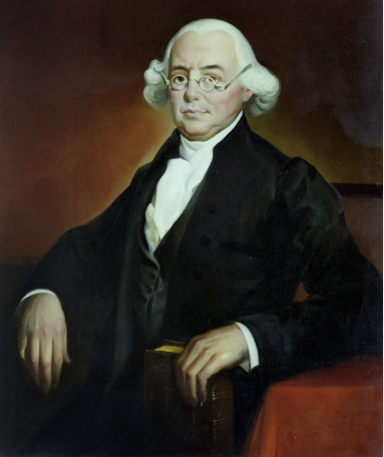
WAYNE COUNTY — This July marks the 250th anniversary of the Declaration of Independence. One of the men who signed it built a failed textile factory on a Wayne County creek, died broke in a North Carolina tavern hiding from creditors, and has a sunken ghost town named after him at the bottom of Lake Wallenpaupack.
His name was James Wilson. He is buried in Philadelphia now, alongside Benjamin Franklin, but it took 108 years to get him there.
The Man Who Made Them Wait
Wilson arrived in America from Scotland in 1765, a trained lawyer with an introduction letter and nowhere to practice. Within a decade he was handling cases in eight Pennsylvania counties. Within another decade he was in the Continental Congress, publicly demanding separation from Britain — and then, when the vote actually came, asking for three weeks to check with his constituents first.
Pennsylvania was divided. Wilson refused to cast a vote he hadn’t earned. He went home, listened, came back, and voted yes. His signature is on the Declaration of Independence.
That same caution — the instinct to slow down and take stock — apparently did not extend to business.
12,000 Acres He Couldn’t Afford
By the early 1790s, Wilson was one of the most credentialed men in America. He had signed both the Declaration and the Constitution, two of only six people ever to do so. George Washington had appointed him to the first Supreme Court. He founded what is now the University of Pennsylvania Law School. He was, by any reasonable measure, set.
He was also buying land he couldn’t afford.
In 1793, Wilson purchased roughly 12,000 acres from the Penn estate along the Wallenpaupack Creek — the waterway that now sits under Lake Wallenpaupack, straddling Wayne and Pike counties. He was already developing the land before the deed closed, putting up a textile factory near what is now Hawley around 1792, growing flax and hemp with the intention of manufacturing fabric. The operation failed. There wasn’t enough flax. The land was wrong for it, or the scale was wrong, or both. Wilson walked away having spent heavily and made nothing.
It wasn’t his only bad bet. He had already drawn the Holland Land Company into speculative purchases of hundreds of thousands of acres across Pennsylvania and New York. In 1795 he bought into one of the Yazoo land companies, which turned out to be part of a massive fraud scheme in Georgia. By 1797 the whole structure was collapsing.
A Supreme Court Justice in Debtors’ Prison
That year, a creditor caught up with Wilson in Burlington, New Jersey, and had him thrown in jail. He was a sitting Associate Justice of the United States Supreme Court. His son paid the debt to get him out. Wilson fled south, riding court circuits and staying one step ahead of his other creditors. He was briefly jailed again in North Carolina before ending up in Edenton, at the home of a colleague on the bench, Judge James Iredell, who offered him a room.
He never left. Following a bout of malaria, Wilson suffered a stroke and died in Edenton on August 21, 1798. He was 55. He was still, technically, a Supreme Court Justice.
He was the first Justice to die while holding the seat.
His reputation had collapsed so thoroughly that no one organized a return of his body to Philadelphia. He was buried in North Carolina and largely forgotten. It took until 1906 — during the presidency of Theodore Roosevelt — for his remains to finally be brought back to Christ Church graveyard in Philadelphia, where they now rest near Franklin, near other signers, near the men history remembered more kindly.
The Courthouse Town That Went Underwater
Back in Wayne County, the county seat question was still being sorted out. Wayne County was established in 1798, the same year Wilson died. Milford served briefly as the seat, then the courts moved to Wilsonville — the settlement along the Wallenpaupack Creek on land Wilson had owned — while a permanent seat was built. The town was named for him: a sitting Supreme Court Justice with deed records all over the surrounding land.
Wilsonville held the courts until 1802, when the seat moved to Bethany, then again to Honesdale in 1841, where it has stayed.
Wilsonville itself is gone. Pennsylvania Power and Light (PPL) bought out roughly 100 property owners, razed every structure, rerouted seventeen miles of roads, relocated a cemetery, and flooded the valley in 1926 to create Lake Wallenpaupack. The town that bore Wilson’s name now lies under the water near the dam.
The Most Neglected Founder
Wilson’s obscurity is not accidental, but it isn’t entirely explained by the debt either. He was a complicated figure during his own lifetime — a man who defended Loyalists in court during the Revolution, whose Philadelphia home was attacked by a mob in 1779 and survived only because cavalry arrived in time. Six people died in that fight. His house became known as “Fort Wilson.” He fled the city for weeks afterward.
He argued that sovereignty derived from the people, not from governments — a genuinely radical position at the time — while simultaneously trying to corner land markets for personal gain. He delayed the independence vote out of principle and then spent the rest of his career making decisions he couldn’t sustain.
The historian who wrote the only full biography of Wilson called him “the most neglected of the major American founders.” Penn Law, whose institution he created, has made similar observations.
Pennsylvania is planning events across the state. Wayne County, sitting on the land Wilson bought, the creek he tried to industrialize, and the courthouse town that bore his name, has one of the stranger founding stories in the region — and most people driving past Hawley have no idea it’s there.
The Wayne County Historical Society in Honesdale maintains records on Wilson’s land holdings and the early history of Palmyra Township.