
Update: Five days after this resolution passed, commissioners converted it into permanent law — and then confirmed the emergency that justified it never materialized. Read the follow-up report: Pike County Passed a Permanent Protest Ordinance. The Emergency That Justified It Never Happened.
MILFORD, PIKE COUNTY — This is not an immigration story. It is a government deciding where citizens are permitted to stand when they disagree with that government. The mechanism used today against ICE protesters can be used tomorrow against anyone — gun rights advocates outside the courthouse, residents angry about a tax reassessment, parents at a school board meeting who take it outside. The precedent doesn’t care about the cause.
On April 10, 2026 — nine days after Pike County’s commissioners renewed a two-year contract to house ICE detainees — two of them invoked a county property statute, written to maintain buildings and public welfare, to restrict where citizens can demonstrate against a detention facility that has held immigrants for over thirty years.
They called a special meeting with no public notice to do it. No press. No public comment. Commissioners Matthew Osterberg and Ronald Schmalzle convened, voted, and adjourned in under fifteen minutes. Commissioner Christa Caceres, who voted yes on the ICE contract on April 1, 2026, abstained.
The meeting was designed to not be scrutinized. It worked.
What the resolution does
Resolution 26-10 designates two locations where demonstrations near county government may occur.
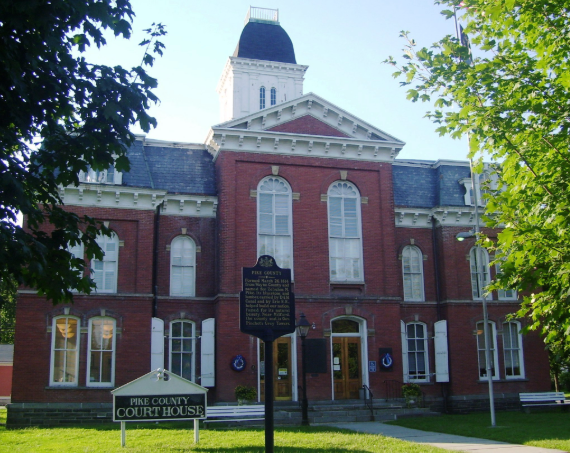
Anyone protesting the Pike County Correctional Facility must do so on a designated patch of county property adjacent to the Emergency Management Communications Center — cordoned off by the correctional facility itself, away from the building being protested. Protesters at the Pike County Courthouse are confined to the lawn and explicitly prohibited from using the bluestone steps.
Osterberg and Schmalzle invoked 16 Pa. C.S.A. § 12509 as their authority — a county code provision that authorizes commissioners to protect county property and public welfare. The statute says nothing about expressive activity. It took effect five days after adoption.
The resolution does not define who enforces the zones, what happens to anyone standing outside them, or what specific threat or incident prompted its passage. None of that is in the record because there is no record. The meeting minutes are four sentences. It is also silent on penalties — anyone who stands outside the designated areas faces consequences that are either nonexistent or entirely at someone’s discretion.

What it followed
The April 1, 2026 commissioners meeting drew direct public challenge over the ICE contract renewal. Resident Isabelle Smith asked the board: “Is that really what we want to be known for?” Solicitor Thomas Farley’s answer was that the county bears no responsibility for detainee due process — it is simply “the entity that holds the individuals.”
Osterberg said ICE will always need room to house people here illegally. Caceres said she has faith in Warden Craig Lowe and that “what is happening in our county is different” from detention operations drawing national scrutiny. She asked her fellow commissioners to study the financial impact of ending the agreement. They haven’t.
The county received $16 million from ICE in 2024 and 2025. The two-year renewal signed April 1, 2026 raised the daily rate from $128 to $178 per detainee.
The abstention
Caceres abstained from Resolution 26-10 without a recorded public explanation. There is no discussion in the minutes, no dissent on the record, no statement of any kind.
An abstention is not a no vote. Caceres voted yes on the ICE contract that protesters were responding to, defended it publicly, and then declined to vote either way when her colleagues moved to contain the protest response.
The legal problem
Courts have consistently held that content-neutral restrictions on public demonstrations must be narrowly tailored to a significant government interest and leave open alternative channels of communication. The question is not whether Osterberg and Schmalzle can regulate time and place on county property — they can. The question is whether routing protesters to a cordon next to a communications building, away from the facility being protested, satisfies the alternative-channel requirement. It doesn’t, by any straightforward reading of the standard.
The Pike County Courthouse steps are specifically named and barred. Those steps have been a site of public demonstration in this county since before Osterberg was born.
Pocono Review covers Pike, Monroe, Wayne, Carbon, Lackawanna, and Luzerne counties.
Tips: tips@poconoreview.com · Corrections: corrections@poconoreview.com